Wolf Range Repair
Wolf Range Igniter Switch: Why It Clicks, Sticks or Goes Silent
A Wolf range igniter switch sits on the gas valve stem behind each knob and tells the spark module to fire when you push and turn it. If burners click nonstop or not at all, dry the burner, seat the cap and cut power for 30 seconds before replacing anything.
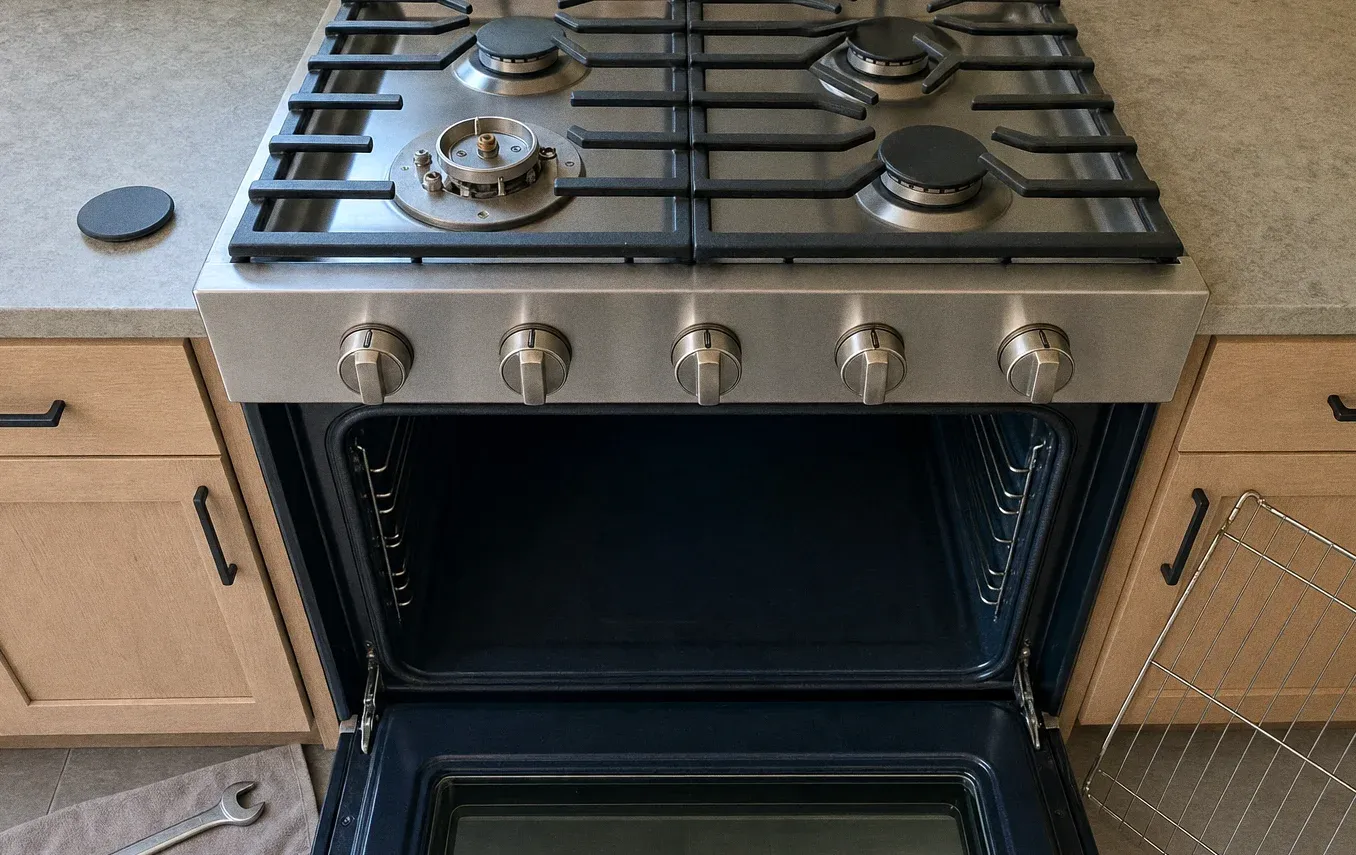
The igniter switch on a Wolf range is a small electrical switch fixed behind each burner knob, on the stem of the gas valve. When you push the knob in and turn it counterclockwise to Hi, the switch closes and signals the spark module, and the burner should catch within about three to four seconds. If the burners click without stopping, never click at all, or click with no flame, the switch is one of four suspects. The other three are a wet or dirty igniter, a burner cap sitting off-center, and the spark module itself. The first checks take about ten minutes and need no tools.
This matters in plenty of Boston kitchens, where a pro range went into an older rowhouse or condominium during a renovation and the outlet behind it may be older than the range. A perfectly good switch can look faulty when the power feeding it is the real problem.
How the switch, module and igniters work together
Each Wolf gas burner sits at the end of a short ignition chain. The switch on the valve stem is the trigger. The spark module, a small box under the cooking surface, produces the high-voltage pulse. The igniter, the ceramic-and-metal electrode beside each burner, is where that spark jumps across and lights the gas. On most ranges every igniter clicks together when any one knob is turned, because they share the module, but only the burner with an open valve actually lights.
That shared wiring makes diagnosis quick. If one burner clicks and lights while another clicks and stays dark, the fault lives at the dark burner, not the switch or module. If nothing clicks from any knob, look at power first and the module second. If clicking carries on after the flame lights, or after the knob is off, suspect a switch stuck closed.
Some clicking is normal. A Wolf igniter fires again on its own whenever the flame flickers or the resistance between electrode and burner changes, which is reignition doing its job. Liquid-propane models can also take a little longer to catch the first time they are used each day.
Matching the symptom to the likely cause
| Symptom | Probable culprit | Owner check | Book a visit if |
|---|---|---|---|
| Clicking continues after the flame lights | Wet burner, cap off-center, switch stuck closed | Dry the burner, reseat the cap, push the knob in and release it | Clicking goes on with every knob off |
| Clicks but one burner will not light | Dirty or cracked igniter, blocked ports | Brush the igniter gently, look at the ports | The igniter is cracked or loose, or you smell gas |
| No click from any knob | No power, tripped breaker, failed spark module | Check the breaker and outlet, cut power for 30 seconds | Power is confirmed and still nothing happens |
| Sparks when nobody is cooking | Outlet wiring or polarity, faulty switch | Turn the breaker off | An electrician first, then a range technician |
Owner checks that are safe to do
Work through these in order, following Wolf’s own advice, before blaming the switch.
- Let it dry. A boil-over or a wet cloth leaves moisture around the igniter, and the spark tracks through the water instead of jumping to the burner. Lift off the grate and cap, then wait or use a hairdryer on its low setting.
- Seat the cap. The burner cap must lie flat and centered on its base. A cap that rocks or sits slightly askew pushes the flame away from the igniter, so the module keeps firing.
- Clean the igniter. If the tip is crusted with food or grease, brush it gently with a soft toothbrush. Never use a wire brush, pin or blade on the ceramic. A cracked, chipped or wobbly igniter has to be replaced, not cleaned.
- Work the knob. Push it in and let go. It should spring straight back. A sauce that has run down behind the knob can gum up the switch and hold it closed.
- Try a smaller pan. Wolf notes that an oversized pan can starve a burner of air, so the flame lifts and the igniter starts clicking again.
- Leave out liners. Foil tucked around a burner base changes where the spark goes, so take any out.
Resetting the switch and checking the power
There is no reset button on the switch itself. In practice a reset means turning the range breaker off for at least 30 seconds, then working each knob so the switch contacts open fully. If a spill has dried inside a switch, the knob can spring back while the contacts stay shut. Then clicking continues with every knob off, and the switch, not the module, is the part to replace.
If the range sparks constantly, Wolf advises checking the outlet wiring and its polarity, since reversed hot and neutral wires will make a spark module misbehave even with perfect switches. If the igniters fire when nobody has touched a knob, have an electrician look at the circuit before any range part is changed.
A power cut is a different situation. The igniters cannot spark without electricity, so surface burners have to be lit by hand with a multi-purpose lighter, knob at Hi. The oven stays off until power returns, because its igniter depends on electricity.
The gas-safety stop point
Stop and call if you smell gas with the knobs off, if a burner has clicked for more than a few seconds without lighting, or if the flame turns yellow, lifts away or pops. Turn the knob off, open a window and wait for the smell to clear before trying again. If it does not clear, leave the house and call your gas utility from outside.
Do not take the control panel off yourself. The switches sit beside gas fittings and the module’s high-voltage leads, and refitting them calls for a leak test afterwards. On a newly installed or converted range, confirm it is set up for the gas your house has; mismatched orifices mean poor lighting and an unsafe flame. Our notes on the order to check a burner that will not light cover the gas side in more detail.
What a replacement involves and typically costs
Replacing an igniter switch on a Wolf range means removing the knobs and front panel, unplugging the harness and swapping the switch on the affected valve; where several burners share a linked switch set, the set is changed together. An igniter is replaced from the top, and the spark module is swapped only once the switches and wiring test clean.
As a typical range, igniter or spark module replacement runs $290–$680. When a stuck switch turns out to sit on a stiff or leaking valve, burner valve service runs $260–$1,050. A firm quote follows diagnosis. Coming out costs a flat $95, which pays for tracing the fault and is subtracted from the bill when you approve the work. We fit factory-approved parts, since a loose generic igniter can leave a burner clicking again within weeks.
Wolf Repair Boston is an independent repair shop. For Wolf range repair in South Boston, Charlestown, Brookline or West Roxbury, call (781) 604-1175 and tell us which knobs click and which burners light; that alone narrows the fault before we arrive.
Still asked afterwards
Where is the igniter switch on a Wolf range?
It sits behind each control knob, clipped onto the stem of that burner's gas valve inside the front panel. Pulling the knob off shows only the stem. Reaching the switch means taking the control panel off, right beside gas fittings and spark wiring, so that step belongs to a technician rather than the homeowner.
Can I reset a Wolf range igniter switch?
There is no reset button, but you can do the equivalent. Switch off the range breaker for at least 30 seconds, then push each knob in and let it spring back out fully. If the igniters still click with every knob off afterwards, the switch contacts are stuck and the switch needs replacing.
Why is my Wolf range igniter not clicking at all?
When no burner clicks from any knob, the range is usually not getting power or the spark module has failed. Wolf igniters are electric, so check the breaker and the outlet first. If power is confirmed and one knob stays silent while the others click, that knob's switch is the likely fault.
Can I light Wolf burners by hand when the power is out?
Yes, but the surface burners only. Hold a long multi-purpose lighter at the burner edge first, then open that knob to Hi, keeping your hand to the side. Leave the oven off until the power is back, because its igniter needs electricity and Wolf says it cannot be lit manually.
What does a Wolf igniter switch or module repair usually cost?
Igniter or spark module replacement typically runs $290–$680, and the firm price comes after the fault is found. Our visit is a flat $95 for the trip and the diagnosis, and that amount is deducted from the repair if you decide to go ahead.